Democracy Part 1

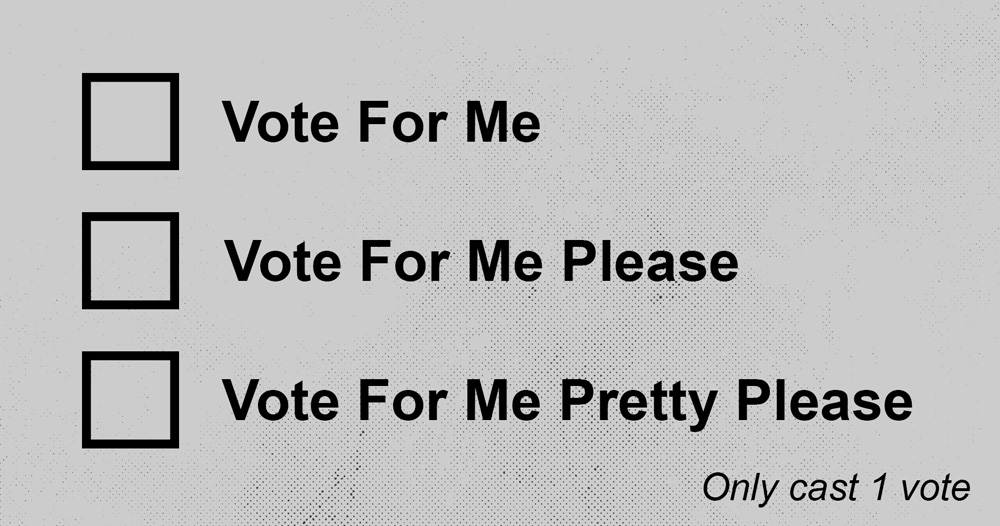
At the entrance there was a smiley faced man who had a brightly coloured paper thing pinned to his jacked and he was greeting everyone with a handshake.

The Vote

One day I went for a long walk with my mother. I was probably 5 or 6 years of age at the time. On the way, my mum explained that she was going to vote. I’m sure she went into some detail, but the only thing I remember was, she didn’t like somebody and this was a way to get rid of them.

Eventually, we arrived at a school – it wasn’t my school. There were lots of people coming and going. My mum told me that one day I would go to this school, but on that day it was being used as a polling station. I didn’t know what that meant or what was wrong with my old school.

At the entrance to the building, there was a smiley faced man who had a brightly coloured paper thing pinned to his jacked and he was greeting everyone with a handshake. I thought it odd that he seemed to know so many people. He looked very happy – too happy for my liking.

My mum just walked right past him dragging me along. I don’t recall what happened next but I was happy when we left and headed home. I do remember asking my mum if the man at the door was the one she didn’t like and she said no – that was another man.

Even at that early age, none of what my mum had told me or what I witnessed, made any sense.

It still doesn’t.


Democracy Part 2 – The Trilemma


© Copyright 2023 – MAC

For the Love of Numbers

Back in my college years, someone mentioned that if an infinite number of monkeys were each given a typewriter, one of them would eventually type out the full works of William Shakespeare.

Numbers! I loved anything to do with numbers.

Why? Because there are only 10 numbers and they are listed in incremental order. There are 26 letters in the alphabet, and they are listed in some meaningless order. Not only that, but the sounds of each letter changes depending upon what other letter(s) they are placed beside in a word. Numbers are simpler to understand. I liked numbers. Maths came easy to me, and by the way, the contraction of mathematics is maths – not math!

While I have not interviewed or studied every species with which we share this planet, I think it’s pretty clear we are the only group that assigns titles to quantities. That is – numbers!

Back in my college years, someone mentioned that if an infinite number of monkeys were each given a typewriter, one of them would eventually type out the full works of William Shakespeare. As a science and maths student, I was fascinated with this notion. That was until I saw a cartoon of a monkey sitting at a typewriter. The caption read “To be or not to be, that is the akfk djn hglg”

This got me thinking about this infinite number of monkeys. Despite all mathematical probabilities, it took only one person to actually write the full works of William Shakespeare, and William didn’t even use a typewriter.

Not to underplay the minds of such intellects, but while mathematics is a means to explain many things, it is not the answer to everything.

For example, in an attempt to make contact with intelligent life on other worlds, we broadcast prime numbers into space. Being of curious mind, I decided to put this to the test and so I read out prime numbers to my cat. Being an intelligent creature as she was, I wondered if my cat would join in and meow out the next prime number in the sequence. You don’t have to be an intellect, or a mathematician, to figure out how successful that was, but the geniuses that thought of broadcasting prime numbers into space should have practised with species from our own world first. An octopus with its nine brains might be a suitable candidate. That’s eight brains more than we have!

Don’t get me wrong, the use of mathematics is a brilliant concept but it needs to be kept in perspective. Astrophysicists have carefully calculated the number of planets orbiting stars within our galaxy that could support intelligent life (meaning, as dumb as we are, plus or minus an IQ or two), as being astronomical – no pun intended. Whoever made that assessment should sit a monkey in front of a typewriter and take notes.

Before we let the universe know of our presence, let us all try and play nice while we can. At some time in the future, an alien race might happen upon us and I seriously doubt whether they will be interested in learning about prime numbers. We will most likely end up as either food or fertiliser.

Please leave your comments below.


© Copyright 2023 – MAC

The Price of Happiness

We all want to be happy but very often, we settle for things that just make us happy. If we opened our minds, we will see that happiness is searching for us.

This is a story about a gypsy and his secret of happiness.

Everybody was talking about the gypsy. My sister and I listened to the women folk as they stood in twos and threes out front – arms crossed and gossiping to each other, each adding their version to the many rumours that were going around about the gypsy. All this did was fuel our curiosity, so despite our mother’s warning to stay away, we went to see the gypsy for ourselves.

In the corner of the field, near the canal, there stood a beautiful gypsy caravan. It was painted in bright colours, reds, blues and greens, and it had carved scrolls painted in bright yellows. Yellow was my favourite colour. My sister liked blue.

The most striking thing about the caravan was how clean it was, as though it had just been freshly painted. Even the wheels were shiny and spotless.

As we ventured closer, I noticed a lot of brass things on the caravan, and they were brightly polished. ‘This must have taken a lot of work,’ I thought. I remembered times when I helped my mum polish the brass stuff at home, so I knew how much work was needed to keep it shining bright.

The top half of the door to the caravan was open. Also, smoke was coming from a chimney pipe sticking out of the caravan’s roof.

“There’s somebody inside,” I said to my sister.

She looked at the smoke and said, “Yes. There must be a stove inside to cook with.”

I didn’t think so, but my sister said that the gypsy had to eat, and if he ate, then he must have a stove. It made sense, but I couldn’t imagine having a stove in such a small place.

My sister was the first to spot the horse, which was no wonder – she liked horses. It was further up the field near where the old tree used to be. It was a big horse, the type that had lots of hair growing around its feet. We were still edging closer to the caravan to get a better look when the bottom half of the caravan door opened, and a man stepped out – it was the gypsy.

He looked old. He had dark sunburnt skin and he wore bright clothes. He saw us, smiled and said, “Why, hello!”

We stood our ground not saying a word. I couldn’t remember if I smiled back or not, but nonetheless, the old gypsy casually went about his business. Just then, a black and white dog appeared from the caravan and stood in the doorway. It looked a bit like my nanna’s dog, but I’d never seen a dog like this one before – its eyes were different colours. One eye light and the other one was dark. The dog just stood there and looked at us.

The old gypsy walked down the steps and waved for us to come and have a closer look at his caravan. He seemed very proud of it.

His dog came down the steps and sat beside his master, and the horse slowly walked over to him and nudged him with his nose. My sister and I laughed. There was something very close between the three of them. We moved closer, and the dog came towards us, wagging his tail – actually, his whole body seemed to wag. We both patted the dog, who then walked back to his master. We followed.

“Who are you?” asked my sister politely.

“I’m an old wanderer,” answered the gypsy.

“Are you eighty-four yet?” I asked.

“Not yet,” he answered. “But what a strange question.”

“Are you happy?” asked my sister.

“My, what a lot of questions,” he said with a laugh in his voice. “Yes, I’m the happiest man alive.”

“Why?” I asked.

“Because, my young squire, I know the secret of happiness.”

“What is it?” asked my sister.

“It’s the greatest secret on earth, but I will share it with you both if you promise me one thing.”

My sister and I looked at each other, and without saying anything, we agreed, nodding our heads.

“You must promise to help and share your good fortune with others less fortunate. You must promise to be good so that others can follow your example. You must promise to be kind and show pity to all creatures. Do you promise?”

“Yes!” we agreed simultaneously.

He took from his pocket two old pennies and gave one to each of us. “Take these pennies, for they shall bring you good luck.”

We took the lucky pennies and held them tight in our hands.

“And now for my side of the bargain – the greatest secret on earth – the secret of happiness. I’m the happiest man in the whole world because I have everything I could ever want.”

“You do?” inquired my sister.

“Yes! I have a place to rest my weary head,” as he turned and with his hand gestured towards his caravan. “I have a faithful friend to take me whenever and wherever I want to travel,” he said as he stroked his horse. “I have a faithful companion to look after me and watch over me as I sleep at night,” he continued, patting his dog. The dog pushed closer up beside him. “And, my fine prince and princess, I be in fine health. I have dined with kings and I have slept amongst beggars. I have loved and have been loved by the most beautiful of women, and I have watched my children play in the fields. I have listened to the wisdom of the elders and I have been granted the opportunity to teach the young. I owe no man and no man owes me. I am who I am and no man has reason to try to change who I am, nor I him. I have the power to make myself happy and I seek no reason to be sad. When I am alone, I am in good company and when I am with others I share my happiness with them. I have a good meal on my table every day and enough to share with my companions and friends – enough to share with the beasts of the fields, titbits to throw to the birds in the sky and crumbs to feed to the fish in the river. I use only what I need and waste nothing. I make friends as I go and leave them with something to remember me by. I have the world within my reach but I own only the things that I can carry. What more could a man ask for?”

“Why did you come here?” asked my sister.

“Is this not a beautiful place to visit? Are you not worthy of my time? Do you not deserve to share my secrets?”

Just then we heard our mother calling us. She was at the side of the field waving. We turned to leave, but as we did so we both stopped, turned back and said goodbye to the old gypsy.

The next day, the field was empty. The gypsy had gone.

If you enjoyed this story, please leave a like or a comment. Or perhaps share it.


© Copyright 2023 – MAC
The Stories We Tell

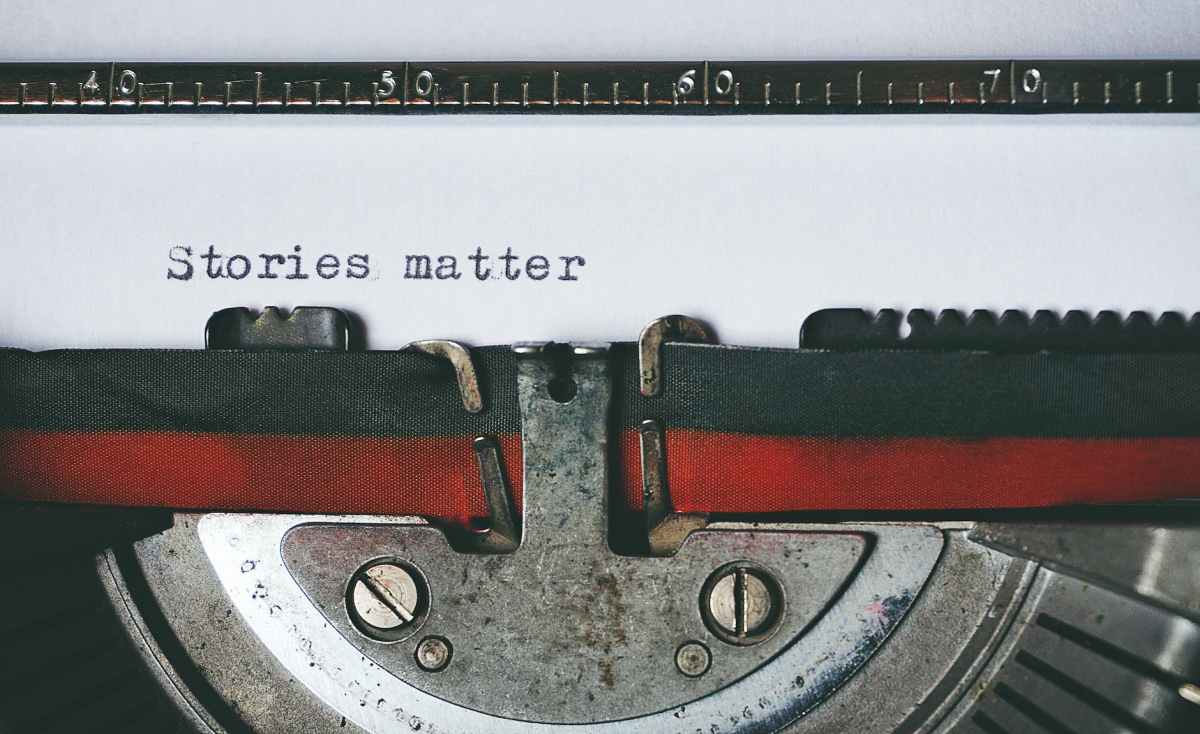
In recent years, it would seem that we have forgotten or ignored the importance of passing on knowledge to our young. Instead, we farm out that responsibility to institutions that try to cram as much information into closed minds as possible.

Throughout history, we have told stories as a means of passing on knowledge and wisdom to the next generation. The Greek storyteller, Aesop [560BC], is credited with writing a host of tales that have been repeated over and over throughout the centuries. Aesop’s Fables, as they are known, were written and told to help teach the young the ways of our kind. My parents would read these fables to me and explain their meanings. Of course, I had my favourites, and although they seemed like simple stories, I understood the meanings behind them. These simple tales have subtly guided and protected me all my life.

Had my parents just told me to do something, it would have gone in one ear and out the other, to quote an old expression. However, when these teachings are wrapped in a story, we become intrigued, our minds are opened wide, and our imagination is invoked. Soon, these thoughts become embedded in our memory, and that’s when they start to have a positive influence on our lives.

In recent years, it would seem that we have forgotten or ignored the importance of passing on knowledge to our young. Instead, we farm out that responsibility to institutions that try to cram as much information into closed minds as possible, most of it apparently, for the sole purpose of passing tests with high grades.

When I was at school, I had my favourite subjects – history was not one of them. BORING! Chanting names of Kings, Queens and dates, and battles and more dates. I hated history with a passion.

Then I went to secondary school, and oh no! – more history lessons! I was not looking forward to this.  

It was my first history lesson at this new school and with a new teacher, and I was all prepared to be bored stupid. The teacher started to draw a map on the board. First, he drew a river. Then he drew some huts at the side of the river, while all the time explaining how dwellers settled there and why. Each history lesson followed from where the last one left off.  Soon there were other pathways and more buildings, and then there was a ferry that crossed the river to the other side. Every lesson got more interesting than the last. This went on until the area became a meeting place with markets, plus more and more buildings were being erected. Our whole class was engrossed in the growth of this settlement that eventually grew into a town.

Just before the end of term – it suddenly stuck us – this was OUR town – wow! Up until then, we just took the town for granted. The teacher then took us on a walking tour around the town and it was a fascinating experience.

I still can’t remember or even care how many wives King Henry VIII had, but I do know more about that town than any other place where I grew up. Why? Because that teacher told us a story.

What is your favourite childhood story, and what did you learn from it?


© Copyright 2023 – MAC

I Want to Ride my Bicycle

The next thing I know, I was lying on the ground looking up at a lot of people looking down at me lying on the ground. This was obviously not a good thing.

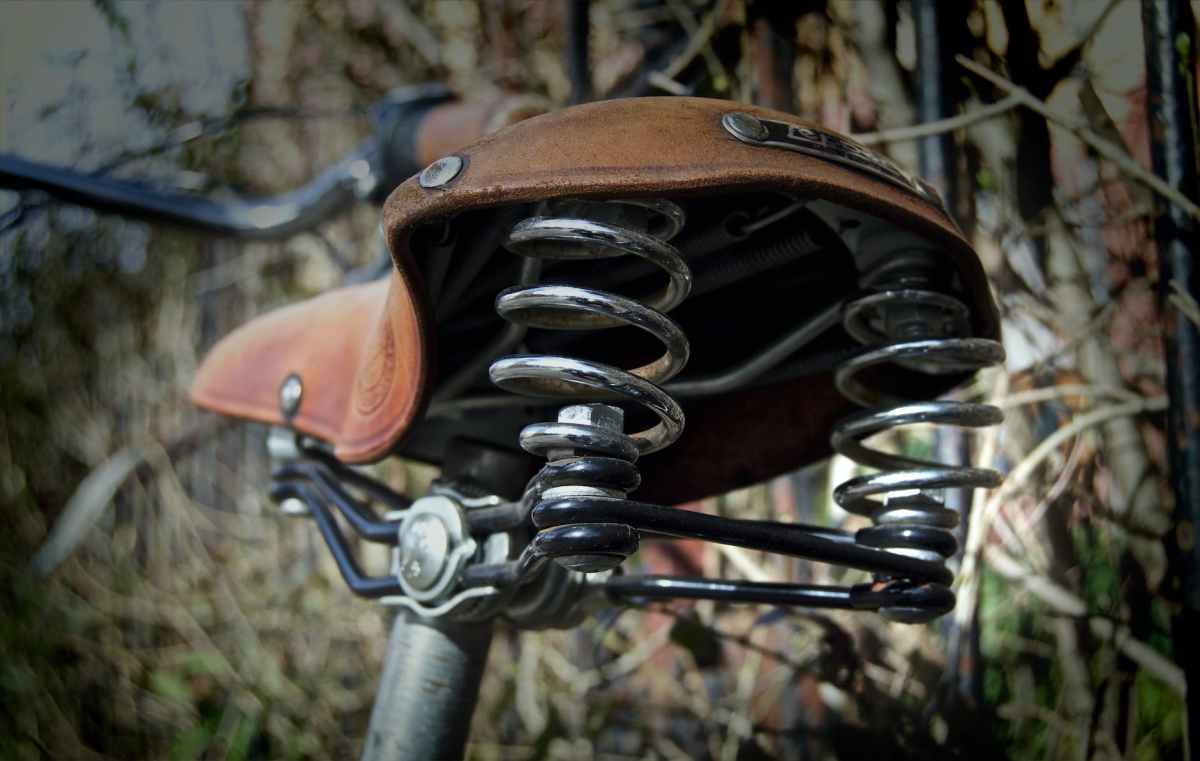
For most kids, learning to ride a bicycle is a right of passage. I was no different. I had long outgrown my tricycle and I wanted a bike, a bike with two wheels – a real bike!

One day, to my complete surprise, my dad came home with a bicycle – it was for me. It wasn’t new. It wasn’t pretty. But it was mine! I was thrilled because I never thought I would ever have my own bike.

After lots of failed attempts, I finally got the hang of keeping balance as long as kept pedalling. Once I had mastered the art of coming to a stop without not falling off, my dad decided to take me for a bike ride. It was just him and me. Me and my dad! I was on top of the world. Off we went riding side by side.

After a while, we stopped at the side of the street and he told me to wait while he crossed the road to go into a shop. I think he was going to buy some cigarettes. I remember him telling me to wait, but after a while I was tired of waiting and so decided to cross the road.

I got hit by a car.

The next thing I know, I was lying on the ground looking up at a lot of people looking down at me lying on the ground. This was obviously not a good thing. So I did what seemed natural at the time – I decided to cry.

Somehow my dad managed to get me and both of our bikes back home where I ran into the house and told my mum I had been run over by a car. My dad corrected me and told my mum I got ‘hit’ by a car.

But this isn’t about riding a bike, or about the dangers of other vehicles. It’s not even about me ignoring my dad’s instructions. It’s about what happened next.

Here’s the interesting part.

A few days later, there was a knock at the door. It was the man who had been driving the car – the car I had ridden in front of. Out of concern, he had come by to see if I was alright. Dad invited him in and they chattered while my mum made a pot of tea.

Then my dad told me to tell the man that I was sorry for what I had done. Let that sink in for a moment! It had been my fault and therefore I had to apologise.

Today, we are warned from a legal perspective to never say sorry, citing that it can be construed as an admission of guilt. I have bumped into doorposts and instinctively said sorry – it’s what we do. Things like this are sewn into our very fibre. I’m reminded of a line from my favourite Star Trek series – ‘Star Trek Enterprise’ – “We can’t save humanity without holding on to what makes us human.”

In that moment I was taught that we are accountable for our actions. If we don’t learn this early enough in life, we would grow up believing we are can do whatever we want without consequence. I may apologise to the odd door post or two, but I’m not sorry if this if this offends anyone.

See also – A Moral Dilemma


© Copyright 2023 – MAC

Think

All this talk about thinking got me thinking about thinking. What is it that we think about? Once I started to think about it, apparently it seems that I think about lots of things.

This was many years ago – the company I was working for had, for whatever reason, decided to move its computer operations to a new data centre. I was part of a team invited to a tour of the new facilities.

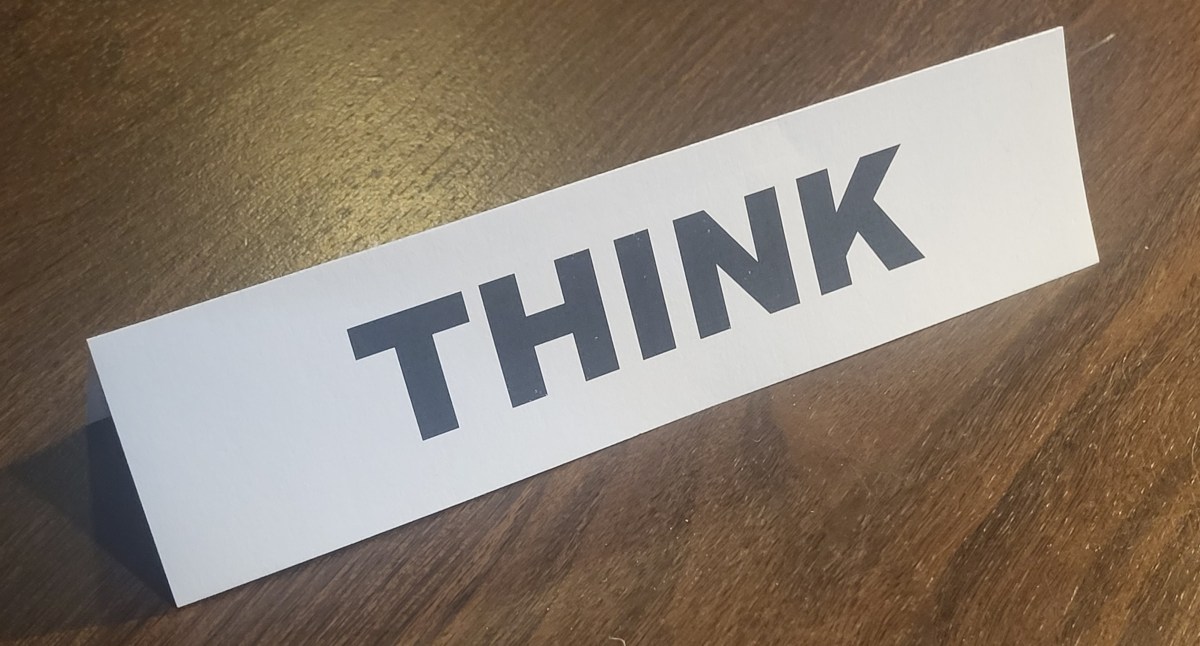
As we were shown around the offices, I couldn’t help but notice that standing on every employee’s desk was a small folded card. The word – THINK – was printed in bold letters on both sides of the card. I was somewhat perplexed, so I asked what they were for. With some patronising overtones, I was enthusiastically told – like this was some super gift to mankind – that they were there to remind people to think. I got the feeling that I had just been given a peek inside the doors of the inner circle, and I should have felt honoured!

Perhaps these cards were a gimmicky desk-top version of the proverbial “Thinking Cap”. The thought crossed my mind that maybe they should also remind these same people to breathe since they were incapable of thinking by themselves. This company unashamedly flaunted the notion they only hire the very best, so I just wondered where they found so many non-thinkers.

The French philosopher Rene Descartes once said, “I think, therefore I am.” So, since these sorry souls at this company needed to be reminded to think, I deduced that the cards were perhaps a humanitarian effort to prevent them from a life of non-existence.

Sometime after that experience, which incidentally was my only memory of that tour, I heard the expression, “Think outside the Box”.

Wow! Really?

Did that same company invent that little gem – an upgrade to Version 2, perhaps?

Not only do we have to prompt people to think so they can exist, but we also have to supply them with boxes to help them think. Perhaps the practice of thinking outside the box was a step towards weening them off their life-threatening dependence upon boxes.

That’s when I started to think about Schrodinger’s Cat! Would the cat inside the box be thinking about whether it was alive or dead? Or as Schrodinger pointed out, would anyone thinking outside the box know if the cat was either dead or alive, or even what it was thinking. It’s all too quantum.

Hercule Poirot, a character created by Agatha Christie, would frequently remind his associate, Captain Hastings, to use the ‘little grey cells’, referring to the brain. Perhaps it is time to throw away the prompts, the virtual caps, and all the silly boxes, and start using our little grey cells.

All this talk about thinking got me thinking about thinking. What is it that we think about? Once I started to think about it, apparently, it seems that I think about lots of things. Perhaps I’m just paranoid about the Descartes Effect – if I stop thinking, I might just fade away.

But let’s get serious for a moment. Here is what I often think about –

  1. What and Why. These are the analytical question.
  2.  When and Where. These are the investigative questions.
  3.  Who and How. These are the solution questions.

In the comments below, tell me what you think.


© Copyright 2023 – MAC

Brass Monkeys

Wisdom comes in many forms, but for the most part, we fail to acknowledge it. Symbolism helps us make that important connection.

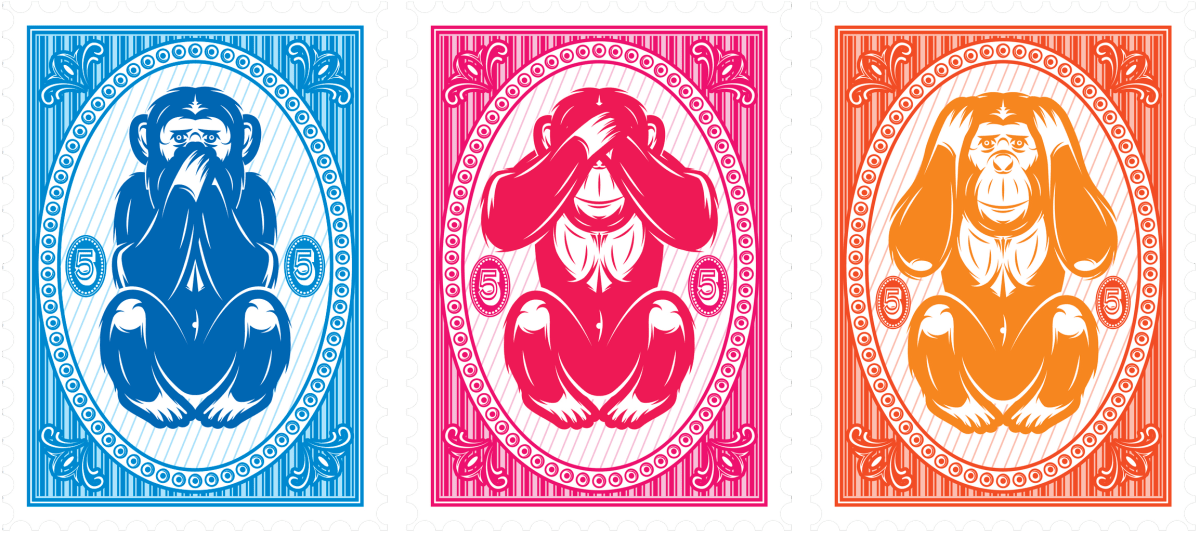
My mum came home from shopping one day and showed me what she had bought. As she unwrapped some brass things, she said they would brighten up the place. Then she unwrapped three little brass monkeys. One monkey had its hands over its ears, another with its hands over its mouth, and the third one had its hands over its eyes.

They were fascinating. What are they I asked.

My dad explained that people will gossip and tell tales about others. He went on to say that the monkey with its hands over its ears was a reminder to not listen to idle tittle-tattle. He added that people who gossip about others will also gossip about them the moment their backs are turned.

My mum always told me that if I didn’t have anything good to say about someone, to keep my mouth shut! She said the monkey with its hands over its mouth is there to remind us of the hurt we can bring to others by spreading nasty stories, especially if they were not true.

I asked my mum and dad about the monkey with its hands over its eyes. They said there are people who are so miserable they can only see misery. They said the monkey with hands over its eyes is to remind us not to look for unnecessary misery otherwise we will become miserable also.

I like monkeys!


© Copyright 2023 – MAC

A Moral Dilemma

Life is simple. Only people make it complicated. The laws of nature and those laws devised by mankind are often in conflict.

I was only 15 – she was 19 – I didn’t care that she was older!
I had a teenage crush on a young lady named Christine Keeler.

Ms Keeler and her friend, Mandy Rice-Davies, were at the centre of a scandal that shocked a nation (Great Britain). The scandal eventually brought the then reigning Government to its knees.  

But this isn’t about rehashing history. The details of this notorious event are well documented and are readily available online. See – The Profumo Affair.

British newspapers being what they are, were all over this story, covering it from every angle possible – and in the midst of all this was me, trying to make some sort of sense of everything I was reading in those papers.

I recall talking to my dad about it while we were working in the garden. We were digging up some potatoes if memory serves me correctly. As we talked, my dad saw that I was having trouble understanding the various aspects of the situation. This was when he said something that changed my life forever.

He said, “Son (he always called me son when he felt he needed to be profound), Son, there is often a big difference between what is morally right and what is legally right.”

This came as a mind-blowing shock because up until then, I thought there was only right and wrong! But suddenly, there were now two variations of what was right!

At that moment, my understanding of the world suddenly got turned upside down. Any thoughts of Christine were temporarily shelved as I focused on the implications introduced by this revelation.

After some deliberations, I asked my dad what I should do if I ever found myself in a position where I had to choose between the two.  My dad said to always do what is morally right. He explained that laws are man-made and can change over time. He added that laws can also vary from place to place. But the same basic morality is inherent in every one of us – it’s who we are – it’s what we are. 

I only wish he had explained this to me much earlier in life. It would have saved me a lot of bother even in those earlier years, especially while navigating my days at school. However, from that day forth, I have always leaned towards doing what is morally right.

In recent years, I have watched with deepening trepidation the widening gap between what is morally right and what we deem as being legally right. Not only that, but it seems that the further these two states drift apart, the more divided we all become.  The Greek philosopher Aristotle is credited with proclaiming that nature abhors a vacuum. In the same sentiment, the vacuum created between these two states is quickly filled with the less savoury members of society who are ready, willing and eager to exploit the confusion.


Foot Notes:

Here is an iconic B&W photo of Ms Keeler sitting in an Arne Jacobsen chair, taken by photographer Lewis Morley.

Shortly after this picture was published in every British Newspaper – I signed up for a photography course at college and I’ve had a love of B&W photography ever since.


© Copyright 2023 – MAC

The Wise Monkeys

When we start looking for things that are not there, we tend to find what we think we are looking for. As a result, we give credence to something that never existed.

During some research, I came upon a news article regarding the University of York (UK). It dated back to 2021 when according to various news agencies, the depiction of the 3 Wise Monkeys was taken off the University’s website for reasons that are still somewhat bewildering.

Evidently, this perplexing circumstance began even earlier, when in 2007, a group of so-called activists claimed that the monkeys were derogatory – a slight towards people whose skin colour is darker that the average Anglo-Saxon. I fail to see the connection – especially in light of the fact, the origins of these monkeys was in India – a country renown for its cast system.

It has also been suggested that the monkey with its hand over its eyes was turning a blind eye to evil. So what is it? Are monkeys derogatory or do they symbolise apathy?

This whole affair seems to be somewhat ironic in as much as, on one hand, this took place at a respected University, a place of education and higher learning. On the other hand, we have people inflicting their ignorance upon their educators, who in turn – took the path of least resistance instead of explaining to the protestors what the symbolic three monkeys represent.

It’s not my place to suggest that these educators are ill-qualified to teach at a university, or if they simply wanted to avoid any bad publicity that might be thrown in their direction. Regardless, this isn’t a simple case of the tail wagging the dog, but more about the flea wagging the tail that’s waging the dog.

The University of York, one would assume by its very nature, has an ample supply of intelligent academics. But apparently not.

So, Unlike the University of York, we decided to symbolically display the 3 Wise Monkeys and the teachings they bring to us all.

Further reading – Brass Monkeys


© Copyright 2023 – MAC