The Good Old Days

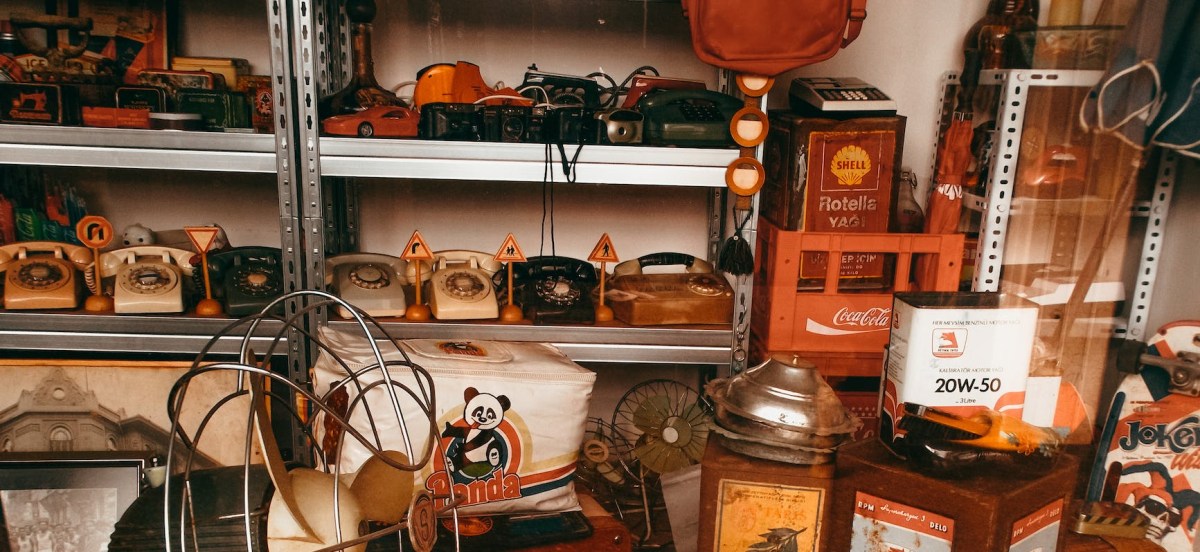
Some people refer to those earlier years as the good old days, but I’m not convinced they were all that good – but then, everyone has a different opinion.

Yes, we elders often talk about days long past, but that’s because we actually lived and experienced them. Some people refer to those earlier years as the good old days, but I’m not convinced they were all that good – but then, everyone has a different opinion.

Let’s take a look at the past century.

Sure, there were the roaring twenties, but there were also two devastating world wars and the great depression. Then we lived under the threat of the cold war. On the homefront, there were the hardships – many people had to make do with what they had. Nothing or very little got thrown away. Just about everything got reused. There were food shortages and so no food was ever wasted. We ate everything given to us. Stale bread got made into toast and any leftover food got made into soup. If and only if, there was anything left over, it was fed to pets or perhaps farm animals. Even a trifle is made from leftovers – hence the name, trifle.

Then there, were the ongoing diseases such as diphtheria, polio, tuberculosis, smallpox, Spanish flu, etc.

Dentistry centred around extractions rather than fillings and most people had dentures by the time they were in their thirties. Nitrous Oxide (Laughing Gas) was the anaesthesia of choice – if you were lucky, otherwise, it was painful. 

Nothing was thrown away. Within a family, a child’s clothes were often handed down from one child to the next. My pram (baby carriage) eventually became my sister’s pram.

Only the very wealthy had cars. The rest of us, if we were lucky, owned a bicycle. Longer trips were made on the bus, and even longer trips were made by train.

I was 11 by the time we lived in a house with an indoors flushing toilet. By the way, toilet paper was yesterday’s newspaper torn into squares.  

I could go on but the point I’m making is, compared to what we have today, one could hardly say those times were Good Old Days!

Having said that – those early days were the happiest days of my life.

Yes, I have had happy times, but overall, I am not particularly happy. I look around and I’m saddened to see so many unhappy people. 

In recent years there seems to have been a general shift in what we deem as happiness. Today, we are encouraged to buy things on the promise that they will make us happy. But when that ‘happy moment’ stops, we experience some sort of withdrawal while we search for something else that will make us even happier.

The corporate ‘drug dealers’ encourage us to trade in our perfectly good mobile phones for the latest models. Bigger and better this and that! Why? What’s more important – having the latest and greatest phone or the phone’s function and purpose?

The KPD factor

Many years ago, I decided to upgrade my stereo system. So off I went to an electronics store. The salesman asked me if I was looking for sound quality or KPD. I already had a stereo system but I wanted one that sounded better, so obviously I was looking for better quality. However, curiosity caused me to ask what was KPD. Knobs Per Dollar! He went on to explain by showing me the Mono-Stereo switch on a Receiver/Amplifier. Why is this here he asked. It will always be set to stereo, so this switch’s only purpose is to make the front panel look complex just for show. At that point he showed me another unit where the focus was about quality of sound. Guess which one I bought?

Happiness comes in many forms but don’t confuse happiness with what makes you happy.  


Let me know what makes you happy in the comments below.


© Copyright 2023 – MAC
For the Love of Numbers

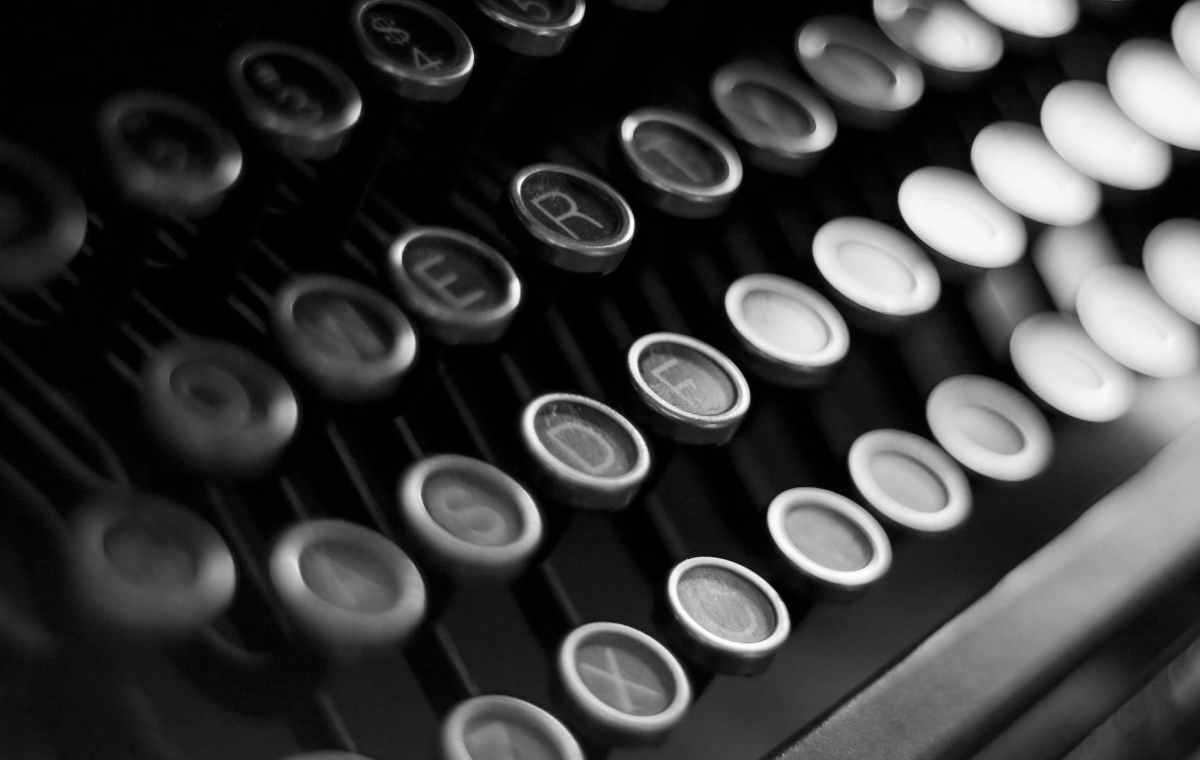
Back in my college years, someone mentioned that if an infinite number of monkeys were each given a typewriter, one of them would eventually type out the full works of William Shakespeare.

Numbers! I loved anything to do with numbers.

Why? Because there are only 10 numbers and they are listed in incremental order. There are 26 letters in the alphabet, and they are listed in some meaningless order. Not only that, but the sounds of each letter changes depending upon what other letter(s) they are placed beside in a word. Numbers are simpler to understand. I liked numbers. Maths came easy to me, and by the way, the contraction of mathematics is maths – not math!

While I have not interviewed or studied every species with which we share this planet, I think it’s pretty clear we are the only group that assigns titles to quantities. That is – numbers!

Back in my college years, someone mentioned that if an infinite number of monkeys were each given a typewriter, one of them would eventually type out the full works of William Shakespeare. As a science and maths student, I was fascinated with this notion. That was until I saw a cartoon of a monkey sitting at a typewriter. The caption read “To be or not to be, that is the akfk djn hglg”

This got me thinking about this infinite number of monkeys. Despite all mathematical probabilities, it took only one person to actually write the full works of William Shakespeare, and William didn’t even use a typewriter.

Not to underplay the minds of such intellects, but while mathematics is a means to explain many things, it is not the answer to everything.

For example, in an attempt to make contact with intelligent life on other worlds, we broadcast prime numbers into space. Being of curious mind, I decided to put this to the test and so I read out prime numbers to my cat. Being an intelligent creature as she was, I wondered if my cat would join in and meow out the next prime number in the sequence. You don’t have to be an intellect, or a mathematician, to figure out how successful that was, but the geniuses that thought of broadcasting prime numbers into space should have practised with species from our own world first. An octopus with its nine brains might be a suitable candidate. That’s eight brains more than we have!

Don’t get me wrong, the use of mathematics is a brilliant concept but it needs to be kept in perspective. Astrophysicists have carefully calculated the number of planets orbiting stars within our galaxy that could support intelligent life (meaning, as dumb as we are, plus or minus an IQ or two), as being astronomical – no pun intended. Whoever made that assessment should sit a monkey in front of a typewriter and take notes.

Before we let the universe know of our presence, let us all try and play nice while we can. At some time in the future, an alien race might happen upon us and I seriously doubt whether they will be interested in learning about prime numbers. We will most likely end up as either food or fertiliser.

Please leave your comments below.


© Copyright 2023 – MAC
Think

All this talk about thinking got me thinking about thinking. What is it that we think about? Once I started to think about it, apparently it seems that I think about lots of things.

This was many years ago – the company I was working for had, for whatever reason, decided to move its computer operations to a new data centre. I was part of a team invited to a tour of the new facilities.

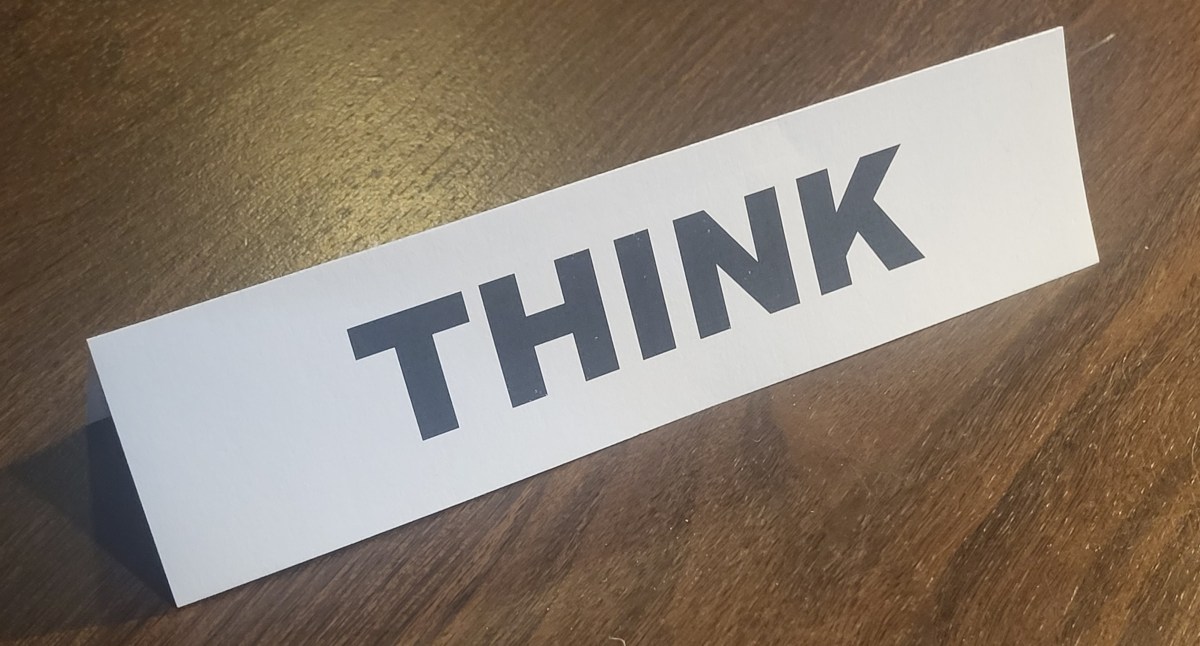
As we were shown around the offices, I couldn’t help but notice that standing on every employee’s desk was a small folded card. The word – THINK – was printed in bold letters on both sides of the card. I was somewhat perplexed, so I asked what they were for. With some patronising overtones, I was enthusiastically told – like this was some super gift to mankind – that they were there to remind people to think. I got the feeling that I had just been given a peek inside the doors of the inner circle, and I should have felt honoured!

Perhaps these cards were a gimmicky desk-top version of the proverbial “Thinking Cap”. The thought crossed my mind that maybe they should also remind these same people to breathe since they were incapable of thinking by themselves. This company unashamedly flaunted the notion they only hire the very best, so I just wondered where they found so many non-thinkers.

The French philosopher Rene Descartes once said, “I think, therefore I am.” So, since these sorry souls at this company needed to be reminded to think, I deduced that the cards were perhaps a humanitarian effort to prevent them from a life of non-existence.

Sometime after that experience, which incidentally was my only memory of that tour, I heard the expression, “Think outside the Box”.

Wow! Really?

Did that same company invent that little gem – an upgrade to Version 2, perhaps?

Not only do we have to prompt people to think so they can exist, but we also have to supply them with boxes to help them think. Perhaps the practice of thinking outside the box was a step towards weening them off their life-threatening dependence upon boxes.

That’s when I started to think about Schrodinger’s Cat! Would the cat inside the box be thinking about whether it was alive or dead? Or as Schrodinger pointed out, would anyone thinking outside the box know if the cat was either dead or alive, or even what it was thinking. It’s all too quantum.

Hercule Poirot, a character created by Agatha Christie, would frequently remind his associate, Captain Hastings, to use the ‘little grey cells’, referring to the brain. Perhaps it is time to throw away the prompts, the virtual caps, and all the silly boxes, and start using our little grey cells.

All this talk about thinking got me thinking about thinking. What is it that we think about? Once I started to think about it, apparently, it seems that I think about lots of things. Perhaps I’m just paranoid about the Descartes Effect – if I stop thinking, I might just fade away.

But let’s get serious for a moment. Here is what I often think about –

  1. What and Why. These are the analytical question.
  2.  When and Where. These are the investigative questions.
  3.  Who and How. These are the solution questions.

In the comments below, tell me what you think.


© Copyright 2023 – MAC